Gisela Albrecht · 2 September 2026
Switzerland's glaciers continue to shrink at an alarming rate according to the latest monitoring reports released by the Swiss Federal Office for the Environment. Data collected from over 90 glaciers show an average loss of 2.5 meters in ice thickness during the past year. The findings underscore ongoing changes in the Alpine environment driven by rising temperatures.
Monitoring Techniques and Recent Observations
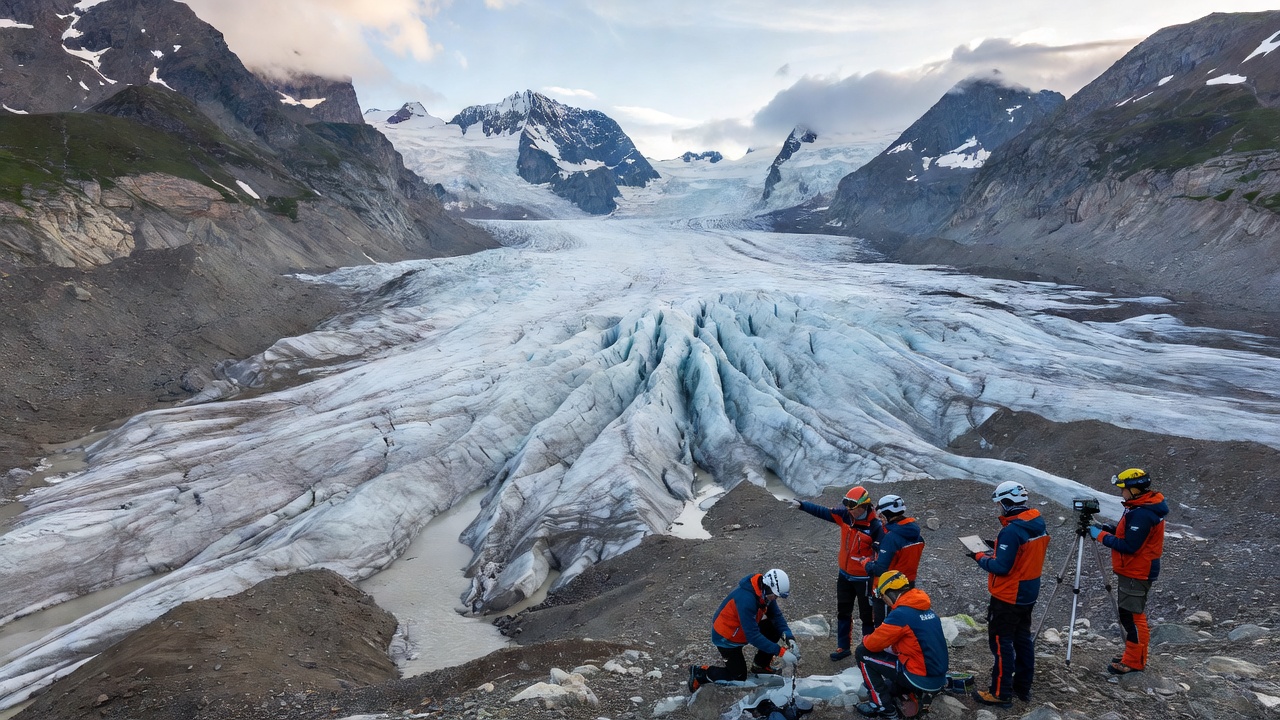
Researchers employ a combination of satellite imagery, ground-based sensors, and aerial surveys to track changes. The Great Aletsch Glacier, the largest in the Alps, has retreated by more than 3 kilometers since 1870, with accelerated loss noted in recent decades. Similar patterns are observed in the Morteratsch and Rhone glaciers. Temperature increases of 1.5 degrees Celsius in the Alpine region over the last century contribute directly to this phenomenon. Annual reports from GLAMOS provide detailed mass balance calculations essential for understanding long-term trends. Experts note that 2022 and 2023 saw record high melt rates due to prolonged heatwaves. Snow cover duration has decreased, leading to earlier exposure of ice to solar radiation. These findings align with broader European climate assessments indicating consistent volume reductions across monitored sites.
Additional data reveal that smaller glaciers are disappearing entirely in some valleys, altering local hydrology and ecosystems. Continuous measurements help predict future scenarios and inform policy decisions at national and international levels.
Effects on Alpine Regions and Cultural Heritage
The retreat affects water resources, as glaciers supply much of the summer meltwater for rivers like the Rhine and Rhone. This impacts agriculture, hydropower generation, and drinking water in surrounding communities. Culturally, traditional practices tied to the mountains, such as alpine farming and festivals, face challenges from changing landscapes. Tourism reliant on glacier views and skiing experiences must adapt to new realities. Conservation efforts include protective measures and public awareness campaigns to preserve the unique Alpine identity. International cooperation through organizations like the Alpine Convention supports sustainable management strategies for these vital natural assets. Local populations report shifts in seasonal activities and increased risks from rockfalls and debris flows as permafrost thaws. Educational programs in schools emphasize the importance of glacial preservation to maintain cultural connections to the landscape.